Thinking about HubSpot CRM Pricing? You’re not alone. Thousands of businesses are weighing costs, features, and value. In this deep dive, we’ll break down every plan, hidden fees, and real-world ROI—so you can decide if HubSpot is worth every penny.
HubSpot CRM Pricing Overview: What You Need to Know

When it comes to customer relationship management (CRM) tools, HubSpot stands out as a leader in inbound marketing, sales, and service automation. But understanding HubSpot CRM Pricing isn’t as simple as picking a plan and paying a flat fee. The platform uses a tiered model across its core hubs—Sales, Marketing, Service, CMS, and Operations—each with multiple pricing levels. This means your final cost depends heavily on which tools you need and how deeply you integrate them.
At its core, HubSpot offers a free CRM that includes contact management, deal tracking, email integration, and basic reporting. This makes it accessible for startups and small businesses. However, as your business scales, you’ll likely need to upgrade to paid tiers to unlock automation, advanced analytics, and team collaboration features.
The Free HubSpot CRM: Is It Enough?
The free version of HubSpot CRM is surprisingly robust. It includes essential tools like:
- Contact and company databases
- Deal and task management
- Email tracking and logging
- Meeting scheduling via HubSpot Meetings
- Basic reporting dashboards
- Integration with Gmail and Outlook
For solopreneurs or very small teams, this might be sufficient. However, limitations become apparent quickly. There’s no automation, limited custom reporting, and no access to advanced workflows or sequences. If your business relies on lead nurturing or multi-step sales processes, the free plan won’t cut it.
“The free HubSpot CRM is a gateway drug to the full platform.” — Marketing Manager, SaaS Startup
Paid Tiers: From Starter to Enterprise
HubSpot CRM Pricing for paid plans starts at the Starter level, which ranges from $15 to $50 per user/month depending on the hub. The Professional tier averages $800–$3,200/year, while the Enterprise tier can exceed $12,000/year for mid-sized companies.
Each tier unlocks deeper functionality:
- Starter: Basic automation, email templates, and simple workflows
- Professional: Advanced segmentation, A/B testing, custom reporting
- Enterprise: Predictive lead scoring, AI-powered insights, sandbox environments
It’s important to note that pricing is per user, per month, and costs scale rapidly with team size. A 10-person sales team on the Professional Sales Hub could pay over $1,000/month before add-ons.
HubSpot CRM Pricing by Hub: Sales, Marketing, Service
One of the most confusing aspects of HubSpot CRM Pricing is that it’s not a single product with one price. Instead, HubSpot structures its offerings around five main “hubs,” each with its own pricing model. Let’s break down the three most popular: Sales, Marketing, and Service.
Sales Hub: Pricing and Features
The Sales Hub is designed for sales teams looking to streamline outreach, track deals, and automate follow-ups. It integrates directly with the core CRM and adds powerful tools like email sequences, meeting links, and call tracking.
Here’s a breakdown of Sales Hub pricing as of 2024:
- Free: Contact & deal management, email tracking, meeting scheduler
- Starter ($15/user/month): 1,000 emails/month, sequences, basic reporting
- Professional ($800/year billed annually): Unlimited emails, A/B testing, custom reporting, workflow automation
- Enterprise ($3,200/year): Advanced permissions, predictive lead scoring, audit logs
One key limitation: the Starter plan limits you to 1,000 tracked emails per month. For active sales teams, this cap can be reached in days. Upgrading to Professional removes this cap and unlocks AI-powered email suggestions.
For more details, visit HubSpot’s official Sales Hub pricing page.
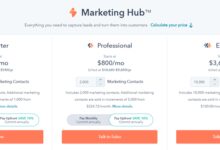
Marketing Hub: Costs and Capabilities
The Marketing Hub is where HubSpot shines for digital marketers. It offers email marketing, landing pages, social media scheduling, and analytics. But HubSpot CRM Pricing for Marketing Hub can escalate quickly based on contact volume and feature needs.
Pricing tiers include:
- Free: Up to 1,000 contacts, basic forms, live chat
- Starter ($50/month): 2,000 contacts, email marketing, landing pages
- Professional ($800/year): 1,000–10,000 contacts, A/B testing, lead nurturing, SEO tools
- Enterprise ($3,200/year): Advanced personalization, multi-domain tracking, custom event tracking
A critical factor: contact limits. If you exceed your plan’s contact cap, you’ll be charged overage fees or forced to upgrade. For example, going from 10,000 to 10,500 contacts on Professional might trigger an upgrade to a higher tier.
Learn more at HubSpot Marketing Hub Pricing.
Service Hub: Support and Ticketing Costs
The Service Hub is tailored for customer support teams. It includes ticketing, knowledge base, live chat, and customer feedback tools. While often overlooked, it’s a vital part of the CRM ecosystem.
HubSpot CRM Pricing – HubSpot CRM Pricing menjadi aspek penting yang dibahas di sini.
Pricing structure:
- Free: 100 tickets/month, knowledge base, customer feedback surveys
- Starter ($50/month): 500 tickets, live chat, automation rules
- Professional ($800/year): SLA management, customer journey mapping, reporting
- Enterprise ($3,200/year): AI-powered chatbots, advanced reporting, custom objects
For growing support teams, the jump from Starter to Professional is often necessary to handle volume and maintain response times. The free plan is only viable for very low-ticket environments.
Hidden Costs in HubSpot CRM Pricing You Can’t Ignore
While HubSpot advertises transparent pricing, several hidden or indirect costs can inflate your final bill. These aren’t always obvious during the sales demo but can significantly impact your ROI.
Overage Fees and Contact Limits
One of the most common pain points is contact overages. HubSpot tiers are often capped by the number of contacts you can store. Exceeding this limit triggers automatic upgrades or overage charges.
For example:
- Marketing Hub Professional supports up to 10,000 contacts.
- If you hit 10,500, you may be charged $50–$100/month in overages—or forced to upgrade to a $2,400/year plan.
This creates a “pricing cliff” where a small increase in contacts leads to a massive jump in cost. Always monitor your contact growth and plan upgrades proactively.
Add-Ons and Bundling Costs
HubSpot encourages bundling hubs for discounts, but this can backfire. While bundling Sales and Marketing Hubs offers a 10–15% discount, you might pay for features you don’t need.
For instance:
- You may only need Marketing Hub Starter but are pushed into Professional for bundling benefits.
- Add-ons like Operations Hub ($400–$1,800/year) or Custom Objects ($500+/year) aren’t included in base plans.
Always audit your actual usage before committing to a bundle. A lean, focused setup often costs less than an all-inclusive package.
Implementation and Onboarding Fees
While not part of the official HubSpot CRM Pricing, implementation can add thousands to your first-year cost. If you lack internal expertise, you may need to hire a HubSpot partner or consultant.
Typical onboarding costs:
- Basic setup: $1,000–$3,000
- Custom workflows & integrations: $5,000–$15,000
- Ongoing managed services: $1,000–$5,000/month
These fees aren’t optional for complex deployments. Factor them into your total cost of ownership (TCO) when comparing HubSpot to competitors like Salesforce or Zoho.
HubSpot CRM Pricing vs Competitors: Is It Worth It?
To truly evaluate HubSpot CRM Pricing, you need context. How does it stack up against alternatives like Salesforce, Zoho CRM, or Pipedrive? Let’s compare on cost, usability, and scalability.
HubSpot vs Salesforce: Cost and Complexity
Salesforce is the enterprise giant, but it comes with complexity and cost. While HubSpot starts free and scales cleanly, Salesforce requires paid plans from the outset.
Comparison:
- HubSpot Sales Hub Professional: $800/year/user
- Salesforce Sales Cloud Professional: $75/user/month ($900/year)
- Salesforce Sales Cloud Enterprise: $150/user/month ($1,800/year)
On paper, pricing is similar. But Salesforce often requires additional costs for training, customization, and third-party apps. HubSpot wins on ease of use and faster time-to-value.
For a detailed comparison, see HubSpot vs Salesforce on G2.
HubSpot vs Zoho CRM: Value for Small Businesses
Zoho CRM is a strong contender for budget-conscious businesses. Its pricing is aggressive, starting at $14/user/month for advanced features.
HubSpot CRM Pricing – HubSpot CRM Pricing menjadi aspek penting yang dibahas di sini.
Key differences:
- Zoho CRM Standard: $14/user/month (includes automation, email templates)
- HubSpot Sales Hub Starter: $15/user/month (limited to 1,000 emails)
- Zoho offers more features at lower price points, but with a steeper learning curve.
However, HubSpot’s user interface, onboarding, and ecosystem of free tools (like the CRM, Academy, and templates) give it an edge in usability and long-term growth.
HubSpot vs Pipedrive: Simplicity vs Depth
Pipedrive is built for sales teams that want a visual pipeline and straightforward pricing. At $14.90/user/month for its Advanced plan, it’s cheaper than HubSpot’s Professional tier.
But HubSpot offers far more depth:
- Integrated marketing and service tools
- Better reporting and analytics
- Superior email tracking and sequencing
If you only need a sales pipeline, Pipedrive is cost-effective. But if you want a full growth platform, HubSpot justifies its higher HubSpot CRM Pricing with integrated functionality.
How to Choose the Right HubSpot CRM Pricing Plan
Selecting the right plan isn’t just about budget—it’s about alignment with your business goals. Here’s a strategic approach to making the best choice.
Assess Your Team Size and Workflow Needs
Start by evaluating your team structure. A solo founder might thrive on the free CRM, while a 10-person sales team will need automation and reporting.
Ask:
- How many users need access?
- Do you run email sequences or cadences?
- Do you need role-based permissions?
If you’re managing complex workflows or multiple teams, Professional or Enterprise tiers are likely necessary.
Map Features to Your Sales and Marketing Funnel
Don’t pay for features you won’t use. Instead, map HubSpot’s capabilities to your customer journey.
For example:
- Top of funnel: Do you need landing pages and lead capture forms? → Marketing Hub
- Middle of funnel: Are you nurturing leads with email sequences? → Sales Hub Professional
- Bottom of funnel: Do you need contract management or quotes? → Consider integrating with HubSpot’s quoting tool or a third-party app
This funnel-based approach ensures you only invest in tools that drive real results.
Plan for Scalability and Future Growth
Choose a plan that accommodates 12–18 months of growth. If you’re hiring aggressively or launching new products, you’ll need room to scale.
Warning signs you’re outgrowing your plan:
- Hitting contact or email limits
- Manual processes replacing automation
- Team complaints about reporting delays
Pro tip: Start with a lower tier and upgrade mid-year if needed. HubSpot allows prorated upgrades, so you won’t lose money on unused time.
Real-World HubSpot CRM Pricing Examples
Theory is one thing—real-world usage tells the true story. Let’s look at three businesses and how their HubSpot CRM Pricing breaks down.
Startup with 5-Person Team
Needs: Basic CRM, email tracking, lead capture, simple workflows
Solution: Free CRM + Marketing Hub Starter ($50/month)
HubSpot CRM Pricing – HubSpot CRM Pricing menjadi aspek penting yang dibahas di sini.
Total Cost: $50/month
This setup works for early-stage startups validating their model. They use free tools for sales and basic email campaigns.
Mid-Sized SaaS Company (20 Employees)
Needs: Sales automation, lead nurturing, customer support, analytics
Solution:
- Sales Hub Professional: $800/year
- Marketing Hub Professional: $1,200/year
- Service Hub Starter: $600/year
- Operations Hub Starter: $400/year
Total Cost: ~$3,000/year (~$250/month)
With bundling discounts, they save 10–15%. They also use HubSpot’s free training resources to reduce onboarding costs.
Enterprise with 100+ Employees
Needs: Advanced automation, AI insights, multi-team collaboration, compliance
Solution:
- Sales Hub Enterprise: $3,200/year
- Marketing Hub Enterprise: $6,000/year
- Service Hub Enterprise: $3,200/year
- Custom implementations and integrations
Total Cost: $12,000–$20,000+/year + $10,000+ in implementation
At this level, they likely have a dedicated HubSpot administrator and partner support. The ROI comes from centralized data, reduced churn, and scalable growth.
Maximizing ROI on Your HubSpot CRM Investment
Paying for HubSpot is one thing—getting value is another. Many companies underutilize the platform, leaving money on the table.
Train Your Team Effectively
HubSpot Academy offers free certifications in CRM, sales, marketing, and service. Encourage your team to complete courses on email sequencing, reporting, and automation.
Teams that complete training see up to 3x higher adoption rates and 40% better campaign performance.
Automate Repetitive Tasks
One of the biggest ROI drivers is automation. Use workflows to:
- Send follow-up emails after form submissions
- Assign leads based on geography or behavior
- Notify managers when deals stall
Even basic automation can save 5–10 hours per week per sales rep.
Integrate with Other Tools
HubSpot connects with 1,000+ apps via its marketplace. Key integrations include:
- Zoom or Google Meet for meeting tracking
- Shopify or WooCommerce for e-commerce data
- Zapier for custom workflows
These connections enrich your CRM data and eliminate manual entry.
Explore integrations at HubSpot’s Integration Marketplace.
Future Trends in HubSpot CRM Pricing and Features
HubSpot is constantly evolving. Understanding upcoming trends helps you future-proof your investment.
AI and Automation Will Drive Pricing
HubSpot is investing heavily in AI, including features like:
HubSpot CRM Pricing – HubSpot CRM Pricing menjadi aspek penting yang dibahas di sini.
- AI-powered email writing
- Predictive lead scoring
- Chatbot builders
These advanced tools are currently in Enterprise tiers but may trickle down—or come with premium pricing. Expect AI features to become a separate cost center in the next 2–3 years.
Consolidation of Hubs and Simpler Pricing
Feedback from users suggests HubSpot’s hub-based model is confusing. Rumors indicate a potential shift toward a unified platform with modular add-ons—similar to Notion or ClickUp.
This could simplify HubSpot CRM Pricing and make it easier to scale features without switching entire hubs.
More Focus on Operations and Data Governance
As data privacy regulations tighten (GDPR, CCPA), HubSpot is enhancing its Operations Hub with better data cleansing, audit trails, and compliance tools.
Expect this hub to grow in importance—and possibly in cost—as businesses demand more control over their CRM data.
Is HubSpot CRM Pricing worth it in 2024?
Yes—if you’re committed to inbound growth and have the team to leverage its full potential. The free CRM is unbeatable for starters. Paid tiers deliver exceptional value for companies that integrate sales, marketing, and service.
How much does HubSpot CRM cost for small businesses?
Small businesses can start with the free CRM or pay $50/month for Marketing Hub Starter. Most stay under $200/month unless they scale rapidly.
Can I customize HubSpot CRM pricing for my team?
Yes. HubSpot allows per-user pricing and tier selection. You can mix free and paid users, and upgrade/downgrade anytime.
Does HubSpot offer discounts for nonprofits or startups?
Yes. HubSpot’s Startup Program offers up to $100,000 in free credits. Nonprofits can apply for discounts through the Nonprofit Program.
What happens if I exceed my contact limit?
You’ll receive warnings, then be charged overage fees or required to upgrade. Monitor your contact count in the dashboard to avoid surprises.
Choosing the right HubSpot CRM Pricing plan isn’t just about cost—it’s about alignment with your growth strategy. From the unbeatable free tier to enterprise-grade automation, HubSpot offers a path for every business. The key is to start small, measure ROI, and scale intentionally. With the right setup, HubSpot isn’t an expense—it’s a growth engine.
HubSpot CRM Pricing – HubSpot CRM Pricing menjadi aspek penting yang dibahas di sini.
Further Reading:
