Thinking about Salesforce CRM but overwhelmed by its pricing? You’re not alone. With so many plans, add-ons, and hidden costs, understanding Salesforce CRM Pricing can feel like decoding a secret language. Let’s break it down—clearly, honestly, and without the fluff.
Salesforce CRM Pricing: The Big Picture

Salesforce CRM Pricing isn’t just about picking a plan and paying a monthly fee. It’s a layered ecosystem of features, user tiers, and scalability options that can make or break your budget. Unlike many off-the-shelf software solutions, Salesforce operates on a modular, subscription-based model that scales with your business—but only if you understand how it works.
How Salesforce CRM Pricing Works
Salesforce CRM Pricing is based on a per-user, per-month model, but the actual cost depends heavily on the edition you choose, the number of users, and the additional features or clouds you integrate. There’s no one-size-fits-all price, which is both a strength and a challenge.
- Subscription-Based Model: You pay monthly or annually for each user.
- Contract Length: Annual contracts typically offer better rates than month-to-month.
- Custom Quotes: Most businesses get a custom quote based on their specific needs.
According to Salesforce’s official pricing page, entry-level plans start at $25/user/month, but real-world deployments often exceed $100/user/month once add-ons and services are included.
Why Salesforce Doesn’t List Transparent Pricing
You won’t find a simple price list on Salesforce’s website—and there’s a reason. The platform is highly customizable, and pricing depends on so many variables that a flat rate wouldn’t reflect actual usage. However, this lack of transparency can frustrate small businesses and startups trying to budget.
“Salesforce doesn’t sell software; it sells transformation.” — Marc Benioff, CEO of Salesforce
This mindset explains why pricing is consultative. Salesforce wants to understand your business before quoting a price, ensuring you buy into a long-term partnership, not just a tool.
Salesforce CRM Pricing by Edition
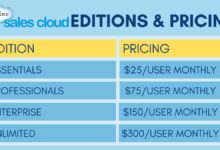
The core of Salesforce CRM Pricing lies in its different editions. Each edition unlocks more functionality and is priced accordingly. Choosing the right one is critical to balancing cost and capability.
Salesforce Essentials: The Entry Point
Salesforce Essentials is designed for small businesses with up to 10 users. It’s the most affordable entry into the Salesforce ecosystem, starting at $25/user/month.
- Basic contact, lead, and opportunity management
- Email integration and task tracking
- Mobile app access
- Limited customization and automation
While it’s a great starting point, Essentials lacks advanced reporting, workflow automation, and multi-channel support. As your team grows, you’ll likely need to upgrade. Learn more at Salesforce Essentials Pricing.
Salesforce Sales Cloud: The Core CRM Engine
Sales Cloud is the flagship CRM product and the most widely used Salesforce edition. It’s where Salesforce CRM Pricing gets more complex, with four main tiers:
- Professional: $80/user/month – Includes lead and opportunity management, email integration, and basic automation.
- Enterprise: $165/user/month – Adds advanced customization, workflow rules, and API access.
- Unlimited: $330/user/month – Full feature set, 24/7 support, and sandbox environments.
- Lightning Professional: A newer version of Professional with modern UI and improved tools.
Sales Cloud is ideal for sales teams that need pipeline visibility, forecasting, and automation. However, the jump from Professional to Enterprise nearly doubles the cost—so evaluate whether you truly need API access or complex workflows.
Salesforce Service Cloud: For Customer Support Teams
If your focus is customer service, Service Cloud is essential. It starts at $75/user/month for the Digital Edition and goes up to $165/user/month for the Unlimited Edition.
- Case management and omnichannel support (email, chat, phone)
- Knowledge base and self-service portals
- AI-powered service with Einstein Bots
- Advanced analytics and SLA tracking
Service Cloud integrates seamlessly with Sales Cloud, but pricing stacks. If you’re using both, expect to pay for each user in both clouds. Check out Service Cloud Pricing for full details.
Salesforce CRM Pricing for Marketing and Commerce
Salesforce isn’t just for sales and service. Its marketing and commerce clouds add another layer to Salesforce CRM Pricing, especially for businesses focused on digital engagement.
Marketing Cloud: Email, Ads, and Automation
Marketing Cloud is one of Salesforce’s most powerful—and expensive—offerings. Pricing is not publicly listed and requires a custom quote, but estimates range from $1,000 to $40,000+ per month depending on volume and features.
- Email Studio, Mobile Studio, Social Studio, and Advertising Studio
- Journey Builder for customer journey automation
- Data and AI analytics through Datorama and Einstein
- Integration with Sales and Service Clouds
Small businesses rarely use full Marketing Cloud. Instead, many opt for Pardot, Salesforce’s B2B marketing automation tool, which starts at $1,250/month for up to 10,000 contacts.
Commerce Cloud: For E-Commerce Businesses
Commerce Cloud is designed for brands running online stores. Like Marketing Cloud, it requires a custom quote, but entry-level plans start around $1,500/month.
- Headless commerce architecture
- AI-driven product recommendations
- Order management and inventory sync
- Integration with MuleSoft for backend systems
Commerce Cloud is ideal for mid to large-sized retailers. However, the implementation cost can exceed the subscription fee, especially if you need custom development.
Hidden Costs in Salesforce CRM Pricing
The listed price is just the beginning. Many companies underestimate the total cost of ownership (TCO) because of hidden fees and add-ons. Understanding these is crucial to avoiding budget overruns.
Implementation and Consulting Fees
Implementing Salesforce often requires third-party consultants or Salesforce partners. These services can cost anywhere from $5,000 to $100,000+, depending on complexity.
- Data migration from legacy systems
- Custom workflow and automation setup
- User training and change management
Some businesses try DIY setups, but without expertise, this can lead to poor adoption and wasted licenses. According to Gartner CRM reviews, 60% of Salesforce projects exceed their initial budget due to underestimating implementation costs.
AppExchange Add-Ons and Integrations
Salesforce’s AppExchange hosts over 5,000 apps that extend functionality. While some are free, many are paid—and these costs add up.
- Document signing (e.g., DocuSign): $15–$50/user/month
- Advanced reporting (e.g., Tableau CRM): $75/user/month
- Telephony integration (e.g., Aircall, Five9): $30–$100/user/month
Before committing, audit your must-have integrations and factor them into your total cost.
Training and Adoption Costs
Even the best CRM fails if users don’t adopt it. Salesforce offers Trailhead for free training, but many companies invest in paid training programs.
- Internal champions or admin training: $1,000–$5,000
- Custom training materials and workshops
- Ongoing support and user help desks
Low adoption rates can render your Salesforce investment useless. Budget for change management from day one.
Salesforce CRM Pricing for Small vs. Large Businesses
How Salesforce CRM Pricing impacts your business depends on your size, industry, and growth stage. Let’s compare how different organizations experience the platform.
Small Businesses: Balancing Cost and Capability
For small businesses, Salesforce CRM Pricing can seem steep. Essentials is affordable, but limited. Many SMBs start with Sales Cloud Professional at $80/user/month.
- 5 users = $400/month ($4,800/year)
- Add Pardot: +$1,250/month
- Implementation: +$10,000 one-time
Total first-year cost: ~$27,050. That’s a big investment for a small team. Alternatives like HubSpot or Zoho may offer better value for early-stage companies.
Mid-Sized Companies: Scaling with Salesforce
Mid-sized businesses (50–500 employees) often use Enterprise or Unlimited editions. They benefit from automation, reporting, and integration capabilities.
- 50 users on Sales Cloud Enterprise: $8,250/month
- Service Cloud for 20 agents: $3,300/month
- Marketing Cloud Starter: ~$2,000/month
- Annual implementation and support: $50,000
Total annual cost: ~$230,000. At this scale, Salesforce delivers ROI through efficiency, but requires dedicated admin and IT support.
Enterprise Organizations: Full Suite Integration
Large enterprises use multiple Salesforce clouds across departments. Pricing becomes less about per-user cost and more about strategic value.
- Global deployment across sales, service, marketing, and analytics
- Custom development and MuleSoft integration
- Dedicated success managers and premium support
Annual contracts can exceed $1M. However, the ability to unify customer data across touchpoints justifies the cost for many Fortune 500 companies.
How to Reduce Salesforce CRM Pricing Costs
You don’t have to pay full price. There are smart ways to optimize your Salesforce CRM Pricing without sacrificing functionality.
Negotiate Your Contract
Salesforce pricing is negotiable, especially for annual or multi-year contracts. Larger user counts give you more leverage.
- Ask for discounts on multi-year commitments
- Negotiate bundled cloud pricing
- Request free training or implementation credits
Many customers report 10–20% discounts just by asking. Always involve a procurement or sales negotiation expert.
Optimize User Licenses
Not every employee needs a full Salesforce license. Use lower-cost or limited-access licenses where possible.
- Chatter Only: $5/user/month – For internal communication
- Customer Community: $7/user/month – For external partners or customers
- Platform Licenses: For developers or users running custom apps
Regularly audit user activity to deactivate unused licenses and reclaim costs.
Leverage Free Tools and Trailhead
Salesforce offers powerful free resources that reduce dependency on paid consultants.
- Trailhead: Free interactive learning platform for admins and users
- Developer Edition: Free sandbox for testing and training
- Lightning App Builder: Customize interfaces without code
Investing time in Trailhead can save thousands in consulting fees.
Salesforce CRM Pricing vs. Competitors
Is Salesforce worth the premium? Let’s compare it to top alternatives.
Salesforce vs. HubSpot CRM
HubSpot offers a free CRM with paid tiers starting at $50/month. Its interface is simpler, and pricing is more transparent.
- HubSpot: Easier setup, better for SMBs
- Salesforce: More powerful, scalable, but complex
If you need deep customization and enterprise-grade tools, Salesforce wins. For startups and small teams, HubSpot may offer better value.
Salesforce vs. Zoho CRM
Zoho CRM starts at $14/user/month and includes many features Salesforce charges extra for, like automation and telephony.
- Zoho: Budget-friendly, all-in-one
- Salesforce: More integrations, stronger ecosystem
Zoho is ideal for cost-conscious businesses. Salesforce is better for those planning long-term growth and integration.
Salesforce vs. Microsoft Dynamics 365
Dynamics 365 starts at $65/user/month for Sales Enterprise and integrates tightly with Microsoft 365.
- Dynamics: Best for Microsoft-centric organizations
- Salesforce: More flexible, cloud-native, and feature-rich
If your team lives in Outlook and Teams, Dynamics may feel more natural. Otherwise, Salesforce’s innovation edge often justifies the higher cost.
Future Trends in Salesforce CRM Pricing
Salesforce CRM Pricing isn’t static. The platform evolves with market demands, technology, and customer feedback.
AI and Einstein Integration
Salesforce is embedding AI across all clouds. Features like Einstein Analytics, Einstein Next Best Action, and Einstein Bots are becoming standard—but may increase pricing.
- AI-driven insights require more data processing and computing power
- Future editions may bundle AI or charge separately
- Expect premium pricing for advanced AI features
Businesses should prepare for AI to become a cost factor in Salesforce CRM Pricing.
Subscription Model Evolution
Salesforce may shift toward usage-based pricing or hybrid models, especially for Marketing and Commerce Clouds.
- Pay-per-email or pay-per-transaction models
- More flexible licensing for part-time users
- Increased focus on ROI-based pricing
These changes could make Salesforce more accessible to smaller businesses.
Increased Focus on ROI and Value Selling
Salesforce is moving from feature-based to value-based selling. Instead of listing features, reps will focus on ROI, customer lifetime value, and business outcomes.
- Pricing tied to performance metrics
- More success-based contracts
- Greater emphasis on customer success teams
This shift could make Salesforce CRM Pricing more justifiable for executives focused on results.
Is Salesforce CRM worth the price?
For businesses that need scalability, deep customization, and a unified customer platform, yes. Salesforce CRM Pricing is an investment in long-term growth and operational efficiency. But for small teams or those needing basic CRM functionality, the cost may outweigh the benefits.
Can you get Salesforce CRM for free?
You can access a free Developer Edition for learning and testing. Nonprofits may qualify for discounted or free licenses through the Salesforce Power of Us program. However, production use requires paid licenses.
What is the cheapest Salesforce CRM plan?
Salesforce Essentials at $25/user/month is the cheapest full CRM plan. For even lower cost, Chatter Only licenses at $5/user/month offer basic collaboration.
How much does Salesforce CRM cost for 10 users?
For 10 users on Sales Cloud Professional: $800/month. With Service Cloud: +$750/month. Add-ons and implementation can double that. Expect $1,500–$3,000/month total.
Does Salesforce offer discounts for nonprofits?
Yes. Through the Power of Us program, eligible nonprofits can get Salesforce CRM at 80–90% off. Some even receive free licenses. Learn more at Salesforce for Nonprofits.
Salesforce CRM Pricing is complex, but not impossible to master. From Essentials to Unlimited, from small teams to global enterprises, the right strategy can make Salesforce a powerful ally. The key is understanding not just the sticker price, but the total cost of ownership, the value delivered, and the alternatives available. Whether you’re just starting out or scaling up, take the time to evaluate your needs, negotiate wisely, and plan for long-term success. Salesforce isn’t cheap—but for the right business, it’s priceless.
Further Reading:
